
Table of Contents
DYZAGRO LIQUID — Product dossier
Company: Akharv Zoocare Pvt Ltd — DYZAGRO LIQUID
Indication (quick summary): Rapid supportive oral drench for impaction/constipation; reduces tympany, gas & flatulence; supportive in mild acidosis and dyspepsia; improves appetite, feed conversion and metabolic rate; immune-support & faster recovery in traumatic/infectious/ fibrotic conditions. Best-in-class formulation designed for consistent, cost-effective results.
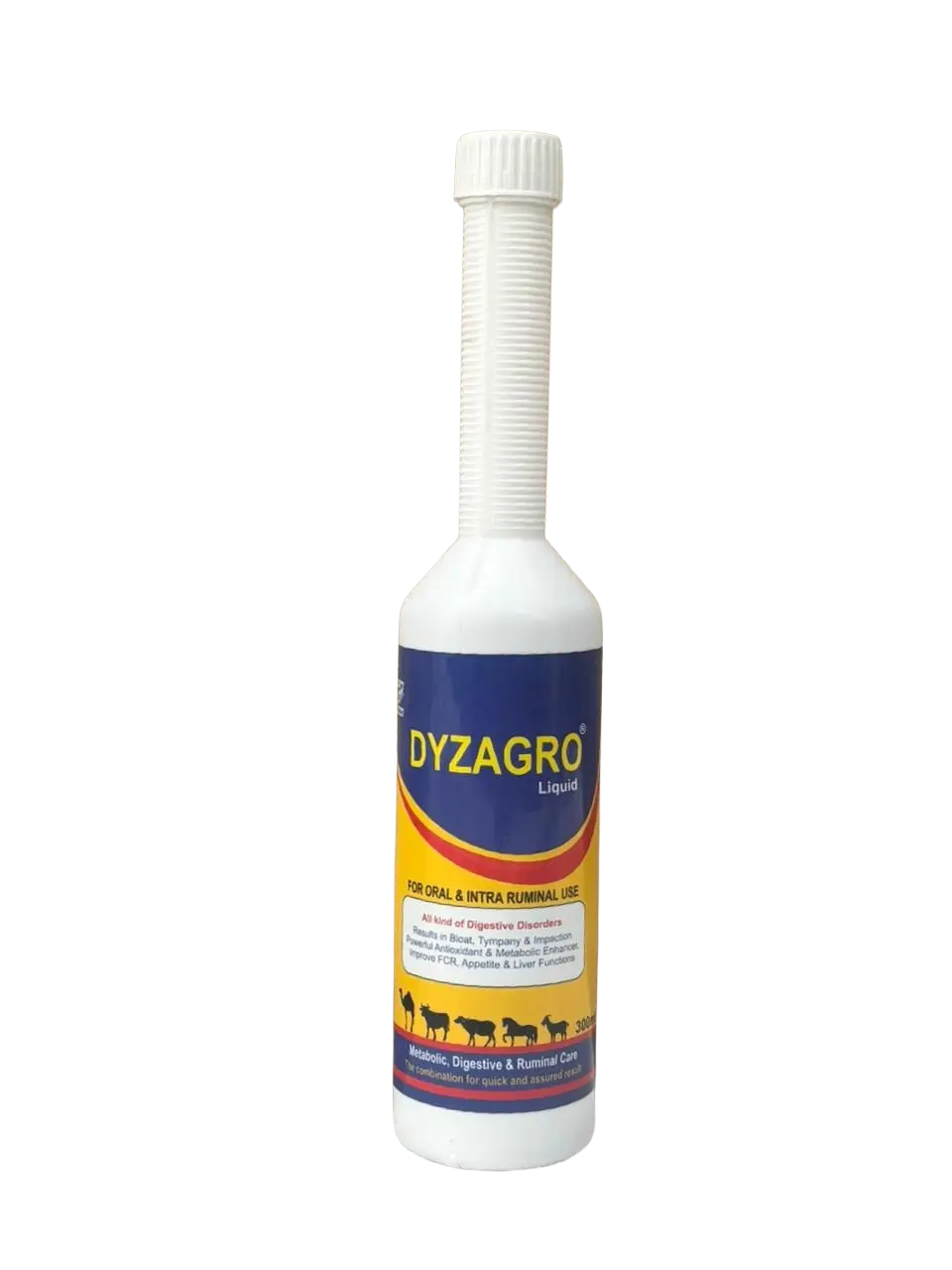
1) Composition (per recommended unit — as provided)
- Ascorbic acid (Vitamin C) — 1500 mg
- Citric acid — 300 mg
Amino acids - DL-Methionine — 280 mg
- L-Lysine — 280 mg
Choline - Choline chloride — 1500 mg
Digestive enzymes - Alpha-amylase — 80 mg
- Papain — 80 mg
Minerals - Zinc sulphate — 200 mg
- Cobalt chloride — 10 mg
- Magnesium sulphate — 60 mg
- Sodium acid phosphate — 60 mg
Metabolic precursor / vitamins - Prosopis (plant extract) — (listed)
- Niacinamide (Vitamin B3) — 50 mg
Liver stimulant herbs - Bhrangraj (Eclipta alba) — 80 mg
- Bhui Amla (Phyllanthus/Phyllanthus niruri family) — 80 mg
Digestive herbs - Elaichi (cardamom) — 10 mg
- Dalchini (cinnamon) — 10 mg
- Tejpatta (bay leaf) — 10 mg
Laxative herbs - Methi (fenugreek) — 50 mg
- Harad (Terminalia chebula) — 50 mg
- Baheda (Terminalia bellirica) — 50 mg
- Amla (Emblica officinalis) — 50 mg
Carminative herbs - Sonth (dry ginger) — 80 mg
- Pipal (pippali/long pepper or related) — 10 mg
- Kali Mirch (black pepper) — 10 mg
Anti-tympany - Dill seed — 90 mg
- Ajwain (carom seed) — 90 mg
- Hing (asafoetida) — 1 mg
Gut immunity booster - Tulsi (Ocimum sanctum) — 2 mg
- Prosopis cineraria — 50 mg
2) Major roles & mode-of-action — ingredient by ingredient (short, sharp, practical)
Note: wording uses “supports” and “helps” — this is a supportive nutraceutical, not a replacement for specific veterinary therapy.
Core actives
- Ascorbic acid (1500 mg) — potent antioxidant; supports cellular immunity, reduces oxidative stress during infections/trauma, improves tissue repair and appetite; helps restore redox balance in stress/heat/illness.
- Citric acid (300 mg) — mild acidifier; improves palatability and gastric acidity which helps enzyme activity and digestion; can help correct mild alkaloid/rumen pH imbalances.
Amino acids & choline (metabolic / anabolic support)
- DL-Methionine (280 mg) — sulfur amino acid; methyl donor for metabolism, supports keratin, liver detoxification and fat metabolism; helps maintain rumen/microbial protein balance and improves growth & coat/fur quality.
- L-Lysine (280 mg) — essential amino acid for protein synthesis; supports immune proteins and tissue repair; useful in convalescence and growth phases.
- Choline chloride (1500 mg) — methyl donor and lipotropic agent; supports liver function (prevents fat infiltration), improves fat metabolism and milk fat synthesis, aids appetite and energy balance.
Digestive enzymes
- Alpha-amylase (80 mg) — hydrolyses starch to sugars — improves carbohydrate digestion especially in monogastrics and partly in ruminants post-rumen; reduces undigested starch that can ferment and cause gas.
- Papain (80 mg) — proteolytic enzyme from papaya — aids protein digestion, helps soften and break down impacted material and improves nutrient availability.
Minerals & metabolic cofactors
- Zinc sulphate (200 mg) — essential for skin, immunity, enzymatic reactions, appetite and wound healing; supports epithelial integrity of gut and respiratory tract.
- Cobalt chloride (10 mg) — ruminant-specific: required for ruminal microbes to synthesize Vitamin B12 — important for appetite, weight gain and energy metabolism.
- Magnesium sulphate (60 mg) — enzyme cofactor; helps neuromuscular function and stabilizes rumen motility; low magnesium predisposes to digestive upsets.
- Sodium acid phosphate (60 mg) — electrolyte and buffering salt; supports acid-base balance and phosphate supply for energy metabolism (ATP).
Metabolic precursor & B-vitamin
- Prosopis (plant extract) — source of bioactive metabolites and precursors that may support metabolism and antioxidant status (used traditionally for energy/support).
- Niacinamide (50 mg) — B3: cofactor in NAD/NADP; supports energy production, appetite and recovery from metabolic stress.
Liver stimulant herbs
- Bhrangraj (80 mg) & Bhui Amla (80 mg) — traditionally hepatoprotective herbs: support liver function, detoxification and bile flow — helpful where hepatic stress impairs appetite and metabolism.
Digestive & carminative herbs (Elaichi, Dalchini, Tejpatta, Sonth, Pipal, Kali Mirch)
- These herbs stimulate gastric secretions and motility, reduce flatulence by improving gas passage and microbial balance, and increase digestive enzyme release — collectively improving appetite and reducing dyspepsia and ruminal bloat tendencies.
Laxative herbs (Methi, Harad, Baheda, Amla)
- Contain soluble fibre, mild stimulant laxative and mucilaginous compounds — soften impacted material, stimulate bowel movement and normalize transit time. Together they act gently and are suitable for impaction/constipation support.
Anti-tympany mix (Dill seed, Ajwain, Hing)
- Strong carminatives and antispasmodics — reduce gas production, speed gas expulsion, relax rumen/intestinal spasm; hing (asafoetida) in very small amounts helps stop fermentation in gas situations.
Gut immunity boosters (Tulsi, Prosopis cineraria)
- Tulsi is an adaptogen and immune modulator — supports systemic immunity and local gut mucosal resistance. Prosopis adds antioxidant and metabolic support.
3) How the formulation works together (synergy)
- Immediate action: enzymes (amylase, papain) and carminatives (ajwain, dill, hing, ginger) act quickly to reduce gas, soften impacted material and restore gut motility. Citric acid and herbs stimulate digestion so feed is better utilized right away.
- Short-term metabolic support (hours–days): amino acids, choline, niacinamide and minerals help restore energy metabolism, liver function and appetite.
- Medium-term recovery (days–weeks): antioxidants (ascorbic acid, tulsi), hepatoprotectives (bhrangraj, bhui amla) and micronutrients support tissue repair, immune response and improved FCR.
- Overall: formulation targets mechanical (impaction), functional (dyspepsia/acid–base), microbial (rumen balance) and metabolic (energy & liver) problems simultaneously.
4) Indications & expected effects
- Impaction / constipation: softened dung, improved defecation within 12–48 hours; repeated doses may be needed in severe impaction.
- Tympany / acute gas: reduced abdominal distension and belching within 30–120 minutes in many cases when used as an oral drench.
- Mild acidosis / dyspepsia: improved appetite, less off-feed behavior within 24–48 hours when used with feeding management corrections.
- Poor appetite & low FCR: increased feed intake and improved FCR over 7–21 days when used as a course.
- Weakness / recovery support: faster return to normal activity and improved weight gain over 1–4 weeks as supportive therapy.
- Immunity support: fewer secondary infections, quicker recovery from minor infections — measurable over 7–21 days.
5) Dosage & treatment protocols (practical, per-species, condition-based)
Manufacturer recommended baseline:
- Cow, Buffalo, Horse: 150–600 ml daily.
- Sheep, Goat, Dog: 50–150 ml daily.
Below are practical protocols (use clinical judgement and consult a veterinarian for severe cases):
A. Quick response — acute tympany / gas
- Cattle/Buffalo/Horse: Give single oral drench 300–600 ml immediately (select nearer 600 ml for severe tympany). If partial response after 30–60 minutes, repeat once (only under supervision). Combine with passing a stomach tube or trocharization if severe ruminal bloat (veterinary emergency).
- Sheep/Goat: Give 50–100 ml orally; repeat after 30–60 minutes if necessary (max 150 ml).
- Dog: Give 50–100 ml as oral drench (for small dogs use lower end; dogs over 20 kg may get up to 150 ml). Caution: small toy breeds — consult vet; ensure no aspiration risk.
Notes: For acute tympany, combine with physical measures (walking, rumen needle/tube as per vet), and monitor respiration.
B. Impaction / constipation (softening + evacuation)
- Cattle/Buffalo/Horse: Daily 300–600 ml for 2–5 days until feces normalize. For mild impaction, 150–300 ml/day for 2–3 days may suffice.
- Sheep/Goat: 50–100 ml daily for 2–4 days; up to 150 ml for severe impaction.
- Dog: 50–75 ml daily for 1–3 days for mild constipation; 75–150 ml for severe cases (large dogs) — combine with fiber, fluids and vet guidance.
C. Mild acidosis & dyspepsia (supportive, restore rumen function)
- Cattle/Buffalo/Horse: 150–300 ml twice daily or once daily (depending on severity) for 3–7 days, along with feeding management (reduce rapidly fermentable carbohydrates).
- Sheep/Goat: 50–100 ml daily for 3–7 days.
- Dog: 50–75 ml daily for 3–5 days for digestive upset.
D. Appetite stimulation, FCR improvement, metabolic & immune support (convalescence, chronic poor condition)
- Cattle/Buffalo/Horse: 150 ml daily as maintenance; for convalescence 300 ml daily for 7–21 days.
- Sheep/Goat: 50 ml daily maintenance; 100–150 ml daily for 7–14 days in convalescence.
- Dog: 25–50 ml daily maintenance (but user provided 50–150 ml — for small dogs adjust downward, large dogs use 50–150 ml) — for convalescence 50–100 ml daily for 7–14 days.
E. Recovery from trauma / infections / fibrosis (supportive)
- Use as a supportive adjunct to specific therapy: 300–600 ml daily in cattle for 7–21 days depending on severity; sheep/goat 50–150 ml daily; dogs 50–150 ml daily based on size. Use until appetite and clinical signs have normalized.
6) Administration & handling
- Route: Oral drench — can be given directly with dosing syringe/drench gun or mixed with 1–2 L of drinking water (or sprinkling on feed for palatability). For small/young animals, dilute and administer carefully to avoid aspiration.
- Timing: Best given before feeding for prompt action in tympany/impaction; for metabolic support, give with morning feeding to stimulate intake.
- Shake well before use. Keep dosing equipment clean.
- Storage: Store in a cool, dry place away from direct sunlight. Keep sealed. Check label for shelf life & batch details.
- Packaging suggestions: Tamper-evident bottles with dosing cap graduated in ml.
7) Safety, precautions & veterinary notes
- General safety: Well-tolerated in target species when used as recommended. Herbs and enzymes are generally safe but monitor for individual hypersensitivity.
- Pregnancy & lactation: Use with caution in pregnant animals — most ingredients are traditionally considered safe but consult your veterinarian for high doses in pregnant/lactating animals.
- Food-producing animals: If animals are used for milk/meat for human consumption, follow local regulations for any withdrawal period; consult a veterinarian or local regulatory guidance — when in doubt recommend veterinary oversight.
- Concurrent therapy: Safe as supportive adjunct to antibiotics/anthelmintics/fluids — but do not use as sole treatment for severe infections or surgical impactions. In suspected toxicities or severe ruminal disorders, contact vet immediately.
- Overdose: No specific toxicity expected at recommended ranges, but very high volumes could cause electrolyte imbalance or gastrointestinal upset — observe animals for signs of distress.
- Dogs & small animals caution: Provided dosage range can be large for small dogs — dose proportionally by body weight and consult a vet when treating small/companion animals.
8) Practical treatment examples (quick reference)
- Acute bovine tympany (moderate): 450–600 ml DYZAGRO liquid as oral drench once. Monitor — repeat once if incomplete response after 45–60 minutes. Supportive walking and rumen tubing as needed.
- Cow with impaction (moderate): 300 ml daily x 3–5 days, combine with laxative/enema if vet indicated.
- Cow with poor appetite & low FCR (husbandry/transition): 150 ml daily x 14 days; reassess feed formulation.
- Goat with constipation: 50–100 ml daily x 2–3 days; increase water and provide green fodder.
- Dog, postoperative weakness & anorexia (large dog ~25 kg): 75–100 ml daily x 7–14 days as supportive therapy alongside veterinary care.
9) Expected timeline of benefits
- Immediate (minutes–hours): reduced bloat, reduced gas discomfort, some softening of impacted material.
- Short term (24–72 hours): improved appetite, increased fecal passage, improved rumen motility.
- Medium term (7–21 days): improved FCR, better body condition, improved recovery and fewer secondary problems.
- Longer term: improved herd productivity if used appropriately with correct management.
10) USPs of DYZAGRO Liquid claims you can safely use
- “Supports quick relief from tympany and gas.”
- “Gentle natural laxative support for impaction & constipation.”
- “Enzyme-boosted formula to improve digestion and feed conversion.”
- “Liver-support and antioxidant blend to aid recovery and immunity.”
(Avoid absolute cure claims such as “cures disease X” — use “supports”, “helps”, “reduces”)
11) Summary
DYZAGRO LIQUID is an enzyme- and herb-enriched oral drench that provides fast relief from gas/impaction, supports liver and metabolic recovery, boosts appetite and feed conversion, and strengthens immunity — ideal as a first-line supportive supplement during digestive upsets and convalescence, used alongside veterinary treatment when required.
DYZAGRO LIQUID is a veterinary herbal digestive tonic that supports rumen motility and improves overall digestive health in cattle, buffalo, sheep, goats, horses, and dogs.
This unique herbal digestive tonic formulation not only helps in impaction and constipation, but also supports liver function for faster detoxification and metabolism in animals.
With its blend of enzymes, amino acids, minerals, and herbs, DYZAGRO works as an effective appetite booster for cattles, helping increase feed intake and improving FCR.
Farmers and veterinarians trust DYZAGRO Liquid because it is a veterinary herbal digestive tonic that reduces tympany, gas, and flatulence while also supporting liver function naturally.
Regular use of DYZAGRO provides consistent results, acting as a natural appetite booster for cattles, enhancing milk yield, growth, and overall productivity.
The veterinary herbal digestive tonic formula contains Tulsi, Bhringraj, and Bhui Amla to support liver function, boost immunity, and strengthen gut health.
DYZAGRO Liquid is the perfect choice for farmers looking for a herbal digestive tonic that acts as a powerful appetite booster for cattles, helps in metabolic recovery, and supports liver function.
Using DYZAGRO, you ensure that your herd receives a veterinary herbal digestive tonic that promotes healthy digestion, reduces gas and bloat, and supports liver function naturally.
For weak or off-feed animals, DYZAGRO acts as an excellent appetite booster for cattles, while simultaneously serving as a veterinary herbal digestive tonic that strengthens metabolic activity.
Overall , DYZAGRO Liquid is a trusted veterinary herbal digestive tonic, an effective appetite booster for cattles, and a supplement that supports liver function for better productivity and faster recovery.
QUESTIONS RELATED TO DYZAGRO ….
What is the primary role of DYZAGRO LIQUID in disease management?https://youtu.be/QQryGcvo53s
DYZAGRO LIQUID serves as a rapid metabolic and digestive support drench. It is not a replacement for specific veterinary therapy but acts as a “best-in-class” supportive nutraceutical designed to address mechanical, functional, microbial, and metabolic problems simultaneously. Its primary roles include:
• Mechanical Support: relieving impaction and constipation.
• Functional Support: addressing dyspepsia and acid-base imbalances.
• Microbial Support: restoring rumen balance.
• Metabolic Support: aiding liver function and energy metabolism
How does DYZAGRO help with Impaction and Constipation?
Role & Benefits: In cases of impaction or constipation, DYZAGRO works to soften dung and improve defecation, typically yielding results within 12–48 hours. It helps normalize transit time and stimulate bowel movements.
How Ingredients Work:
• Laxative Herbs (Methi, Harad, Baheda, Amla): These contain soluble fibre and mucilaginous compounds that soften impacted material and act as mild stimulant laxatives.
• Papain: A proteolytic enzyme derived from papaya, it helps soften and break down impacted material, improving nutrient availability.
• Immediate Action: The enzymes and carminatives work quickly to soften the impacted mass while restoring gut motility
How does the product assist in treating Tympany (Gas/Bloat)?
Role & Benefits: For acute gas or tympany, the liquid reduces abdominal distension and promotes belching within 30–120 minutes of administration. It speeds up gas expulsion and reduces gas production.
How Ingredients Work:
• Anti-Tympany Mix (Dill Seed, Ajwain, Hing): These are strong carminatives and antispasmodics. They relax rumen and intestinal spasms, while Hing (Asafoetida) helps stop fermentation in gas situations.
• Alpha-Amylase: This enzyme hydrolyses starch into sugars. By reducing undigested starch, it prevents the fermentation that often leads to gas production.
• Digestive Herbs (Ginger, Black Pepper, etc.): These improve gas passage and reduce flatulence.
What is DYZAGRO’s role in recovery from Trauma, Infection, or Fibrosis?
Role & Benefits: DYZAGRO acts as an immune support adjunct during convalescence. It promotes a faster return to normal activity and improved weight gain over 1–4 weeks. It is designed to reduce secondary infections and speed up tissue repair.
How Ingredients Work:
• Ascorbic Acid (Vitamin C): A potent antioxidant that supports cellular immunity and reduces oxidative stress during infections or trauma.
• Zinc Sulphate: Essential for wound healing, immunity, and maintaining the integrity of the gut and respiratory tract epithelium.
• L-Lysine: An essential amino acid required for protein synthesis, vital for tissue repair and immune protein production during recovery.
• Tulsi & Prosopis: Act as adaptogens and immune modulators, supporting systemic immunity.
How does the formulation support Liver Health and Metabolism?
Role & Benefits: The product combats liver stress (which often impairs appetite) and metabolic disorders. It improves fat metabolism and aids in detoxification.
How Ingredients Work:
• Liver Stimulant Herbs (Bhrangraj, Bhui Amla): These are traditionally hepatoprotective herbs that support detoxification and bile flow.
• Choline Chloride: A lipotropic agent that prevents fat infiltration in the liver and improves fat metabolism.
• DL-Methionine: Helps in liver detoxification and fat metabolism.
• Cobalt Chloride: Specifically for ruminants, this mineral is required for microbes to synthesize Vitamin B12, which is critical for energy metabolism.
How does DYZAGRO address Anorexia (Loss of Appetite) and Indigestion?
Role & Benefits: In cases of mild acidosis or dyspepsia, DYZAGRO improves appetite and reduces “off-feed” behaviour within 24–48 hours. It also improves Feed Conversion Ratio (FCR) over a 7–21 day course.
How Ingredients Work:
• Citric Acid: A mild acidifier that improves palatability and gastric acidity, enhancing enzyme activity.
• Digestive Enzymes (Alpha-amylase, Papain): These aid in the rapid breakdown of carbohydrates and proteins, making nutrients immediately available.
• Digestive Herbs (Elaichi, Dalchini, Tejpatta): These stimulate gastric secretions and motility, reducing dyspepsia.
• Niacinamide (Vitamin B3): A cofactor that supports energy production and helps recover appetite during metabolic stress
What is the recommended dosage for acute conditions versus maintenance?
Acute Tympany (Cattle/Buffalo): A single oral drench of 300–600 ml is recommended immediately. If the response is partial, it can be repeated once after 30–60 minutes.
• Impaction (Cattle/Buffalo): A daily dose of 300–600 ml for 2–5 days until feces normalize.
• Recovery/Maintenance (Cattle/Buffalo): 150 ml daily for maintenance; up to 300 ml daily for 7–21 days during convalescence.